


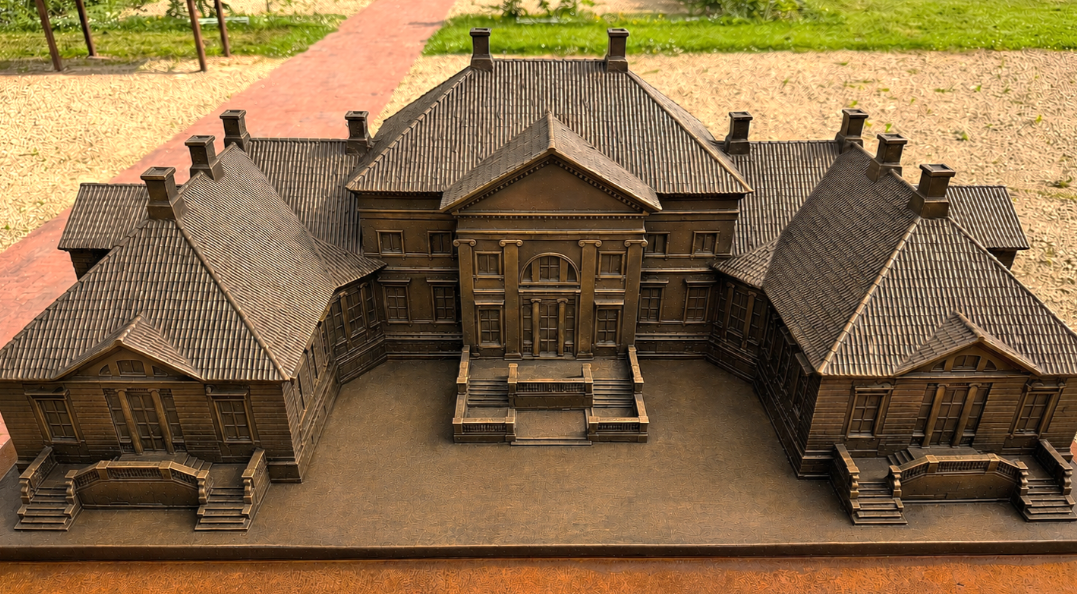
A tactile model
of the historic Iecava Manor House, created by SOCINTEGRA, is now on display in
Iecava Manor Park in the Bauska Municipality. The model allows visitors to
explore the historic manor in a new, accessible and engaging way. It is
complemented by an audio description and information in Braille, helping people
with visual impairments better understand and experience the site.
The Iecava Manor
House, which was destroyed during the First World War, has long been known
mainly through historical photographs, informational materials and digital
resources. Today, its architecture, scale and overall appearance can also be
explored through touch.
The development
of the tactile model took place in several stages. Based on historical sources
and materials from Imants Lancmanis’ book “Iecavas muiža. Gross-Eckau”,
detailed drawings of the manor were first prepared. This was followed by the
creation of a plaster model, while the final stage involved producing a metal
casting of the building.
The Iecava Manor
House model is one of the most remarkable tactile cultural heritage projects
implemented in Latvia in recent years, combining a tactile model, audio
description and Braille information into a single accessibility solution.
The new tactile
model created by SOCINTEGRA has been carefully integrated into the green hedge
labyrinth located in Iecava Manor Park, which allows visitors to walk through
the original floor plan of the manor and understand its spatial layout.
SOCINTEGRA
Chairwoman Marija Kožarina emphasizes: “A 2D plan helps visitors
understand the outline of the manor and the layout of its rooms, but a 3D model
provides much more information. It allows people to explore architectural
details and gain a deeper understanding of the manor’s overall appearance,
offering every visitor a way to discover Iecava Manor that best suits their
needs. It is also important to note that this unique model gives every visitor
the opportunity not only to see history, but literally to feel it with their
own hands.”
Ineta Bramane,
Senior Project Manager at the Development and Planning Department of Bauska
Municipality, adds: “The Iecava Manor House has symbolically returned. Until
recently, it could only be explored through photographs or digital resources,
but today visitors can experience it in a variety of ways. The green hedge
labyrinth, created according to the manor’s exact historical coordinates,
allows visitors to walk through the former layout of the building and
understand its scale and spatial structure. The tactile solutions developed in
cooperation with SOCINTEGRA help make this historic site accessible to all visitors.”
Today, the Iecava Manor House can be experienced in a diverse and modern way at its original historical location thanks to the projects “Green Secrets” and “Recovered History” initiated and implemented by Bauska Municipality and cofinanced by Interreg cross-border program. One element of the project is the green hedge labyrinth, which recreates the former layout of the manor and helps visitors understand its spatial structure. The tactile model created by SOCINTEGRA, in turn, allows visitors to explore the manor’s architecture, façade details and overall appearance through both sight and touch.
In addition, the
“Recovered History” project has created a digital solution that enables
visitors to explore the Iecava Manor House virtually. As a result, this
cultural heritage site is now accessible in multiple ways and to a wide range
of audiences, combining heritage preservation with modern and inclusive
accessibility solutions.
SOCINTEGRA
continues to collaborate with museums, cultural institutions, municipalities
and businesses across Latvia to create environments that are accessible to
everyone. The Iecava Manor House project is another example of how cultural
heritage and historical stories can be made not only visible, but also
touchable and audible.

